

Introduction
Picture this. A game that starts as a late‑night idea with friends ends up on millions of phones and consoles. Behind that story sits not only a clever design, but a market that keeps asking for more people to build the next hit. If career direction matters as much to you as your next project, the job outlook for game developers deserves real attention.
Right now, the United States game market is worth about $57.91 billion and is expected to reach $90.79 billion by 2029. That kind of growth does not only bring in more players; it also drives steady hiring across studios, engines, and platforms. New roles keep opening in programming, design, art, production, marketing, and analytics as teams race to keep up.
At the same time, news about layoffs can make even experienced people second‑guess their path. The wider software field shows a different picture. The U.S. Bureau of Labor Statistics expects software developer jobs, which include many game roles, to grow by 22 percent between 2020 and 2030, faster than most careers. When we zoom in on games, healthy demand and rising pay show that the long‑term job outlook for game developers remains very strong.
This guide helps make sense of the numbers, not just the headlines. You will see how salaries really look, where the best locations and remote options are, which skills matter most, and how careers move from junior to lead. Along the way, we will share how we at Video Game Jobs use our gaming‑only platform to connect this positive job outlook for game developers with real offers for people at every stage.
Key Takeaways
Before we dive into each section, it helps to see the big picture. These points bring together market data and hiring trends in a simple way and show how to act on the strong job outlook for game developers right now.
- Demand for talent tracks market growth, with the U.S. game market at $57.91 billion in 2024 and projected to hit $90.79 billion by 2029. This steady rise supports more roles across code, design, art, and live ops and gives the long‑term job outlook for game developers a solid base.
- Software developer roles, which include many game positions, are projected to grow 22 percent from 2020 to 2030. One report expects about 32,090 extra video game design jobs by 2029, after several years of vacancy growth. Together, these trends point to a field where qualified candidates stay in demand.
- Pay is strong, with game developers earning about $91,009 per year on average and designers around $66,894. Salaries have climbed from about $83,000 in 2020, and mid‑career pros often reach six figures. Experience, shipped titles, and in‑demand skills can push pay well above these averages.
- Location matters. Top‑paying states include Washington, California, New York, and Massachusetts, with metro areas like San Jose, San Francisco, and Seattle offering the highest averages. At the same time, remote work and location‑based pay models are changing how developers think about where to live and work.
- Core skills that keep the job outlook for game developers strong include C++ and C#, Unity or Unreal Engine, cross‑platform development, and version control. On the design side, storytelling, player psychology, UX, and level design stay key. Skills in AI, machine learning, cloud gaming, and data are rising fast.
- Career growth often follows a path from junior to mid‑level, then senior, lead, and director. A big factor is the number and scale of shipped titles on a resume. Pros with several shipped projects usually see better pay, more leadership chances, and more choice in studios and locations.
- A specialized hub like Video Game Jobs gives both candidates and studios a focused space built only around games. We bring together curated listings, career guidance, and industry trend coverage so the strong job outlook for game developers turns into clear options, not noise.
Understanding The Game Development Job Market In 2024

When we talk about the job market for game developers, we are really talking about two things at once: the health of the game market and the demand for software skills. On both fronts, the numbers point in a positive direction for 2024 and beyond. The U.S. gaming market sits near $57.91 billion and is projected to climb to $90.79 billion by 2029, which signals staying power rather than a short‑term spike.
The U.S. Bureau of Labor Statistics groups many game roles under “software developers” and projects 22 percent growth for that group from 2020 to 2030. That rate is much faster than the average across all jobs. More focused reports on games show similar momentum, with job vacancies for video game design roles up about 5.31 percent since 2019. One forecast points to roughly 32,090 new game design jobs being filled by 2029, an annual increase of about 2.28 percent.
Player behavior also supports a strong job outlook for game developers, with research examining (PDF) Does video games' popularity and its relationship to workforce participation showing sustained engagement levels. During the early months of the COVID‑19 pandemic, Microsoft reported a 130 percent jump in multiplayer engagement, and those levels stayed high long after lockdowns ended. Financial results line up with this story. U.S. video game sales hit around $7.91 billion in December 2023, powered by holiday spending, and still reached $5.07 billion in January 2024, up 15 percent year over year.
Platform mix adds even more layers of opportunity:
- About 57 percent of U.S. players use smartphones
- Around 46 percent play on consoles
- Roughly 42 percent play on PCs
That means studios need people who understand mobile free‑to‑play, console performance, PC live service games, and cross‑platform systems. As a result, there is active hiring for programmers, designers, artists, UI and UX experts, data analysts, and QA testers.
The United States also stands as a global talent hub, with nearly 40 percent of game developers worldwide working here. That concentration draws in foreign publishers and new studios, which then hire more local and remote staff. At Video Game Jobs, we track this demand by curating roles across all these disciplines, so the data behind the job outlook for game developers becomes a daily list of real openings rather than just charts.
Salary Expectations And Compensation Trends

Strong demand for skills shows up clearly in pay. For many people, the job outlook for game developers feels most real when they see salary numbers, not just growth rates. The good news is that compensation has been climbing and compares well to other technical fields, especially for experienced staff.
Recent figures put the average U.S. game developer salary around $91,009 per year, or roughly $43.75 per hour. This is up from about $83,000 in 2020, showing a steady rise across several years. Game designers, who tend to focus more on systems and player experience than on deep code, earn around $66,894 on average. Entry‑level designers often start near $57,000, while seasoned pros in both code and design can reach or pass six figures, especially in high‑cost cities or senior roles. With five to nine years of experience, many professionals see pay jump by about 15 percent, especially if they have shipped several titles.
Education And Skill-Based Salary Factors
Education does not tell the whole story, but it still affects how the job outlook for game developers plays out on a personal level. In broad terms:
- Associate degrees can open the door to support or junior roles, especially when paired with a strong portfolio or modding history.
- Bachelor’s degrees in computer science, software engineering, interactive media, or game design remain the most common path into higher‑paying developer and designer positions.
- Master’s degrees and focused graduate programs can move someone into more senior or specialized tracks (engine programming, graphics, AI, or technical design), where pay often rises faster.
- Bootcamps and self‑guided learning give another entry path, especially for people changing careers. Long‑term growth usually depends more on shipped work and proven skills than on any single credential.
At Video Game Jobs, we see roles across all these education levels and highlight requirements clearly so candidates can match openings to their background and growth plans.
Geographic Salary Variations
Where someone lives still shapes how the job outlook for game developers feels in day‑to‑day life. States like Washington (about $138,400 average for software developers) and California (about $137,620, with game developers around $113,668 on average) tend to offer the highest pay. New York and Massachusetts also sit near the top, with averages above $119,000 for software developers.
Metro areas raise the bar even more:
- San Jose–Sunnyvale–Santa Clara: around $157,480 on average
- San Francisco–Oakland–Hayward: near $144,740
- Seattle–Tacoma–Bellevue: around $140,930
Many companies now use location‑based pay even for remote staff. Someone living in a lower‑cost state may get a lower base salary but still enjoy more spending power. When we look at offers on Video Game Jobs, we encourage candidates to compare not just the number on the offer, but also housing, taxes, and quality of life in that area.
Where The Jobs Are – Geographic Hotspots And Emerging Markets

Location still matters for anyone watching the job outlook for game developers, even as remote work grows. Some states and cities hold huge clusters of studios, meetups, and support teams, while others are just beginning to build their game sectors. Knowing the difference can help with both relocation and remote job targeting.
- California is the clear leader in raw headcount, with more than 22,000 game designers and developers. Major hubs like San Francisco, Los Angeles, and the wider Bay Area host AAA publishers, platform owners, and thriving indie scenes.
- Washington follows with more than 16,000 professionals, boosted by companies like Microsoft and Nintendo of America, and anchored by the Seattle area.
- Texas brings in more than 9,800 designers and developers, with Austin standing out as a major game and tech city.
- New York sits around 12,950 designers, mixing AAA offices, mobile studios, and a strong indie presence.
- Virginia and states such as Florida, Illinois, and Georgia also support sizable game communities.
While these hubs offer dense networks, they are not the only places shaping the job outlook for game developers. Some states are posting very fast growth rates in software roles that include game work:
- Utah: projected employment jump of about 61.9 percent from 2018 to 2028
- Nevada: near 42.5 percent
- Colorado: around 40.6 percent
- South Carolina: about 36 percent
- Washington: again appears with 34.6 percent growth
These rising markets can be appealing for early‑career developers who want more room to stand out or who prefer lower living costs.
Remote work creates another path. Many studios now hire fully remote staff or offer hybrid work out of hubs like San Francisco, Los Angeles, Seattle, Austin, Chicago, and New York City. That means someone living in Colorado or Utah can contribute to a studio based in California without moving. On Video Game Jobs, we list roles across each of these hubs, growth states, and remote setups, so candidates can choose between established centers and newer markets that match their goals.
Essential Roles And Skills In Modern Game Development
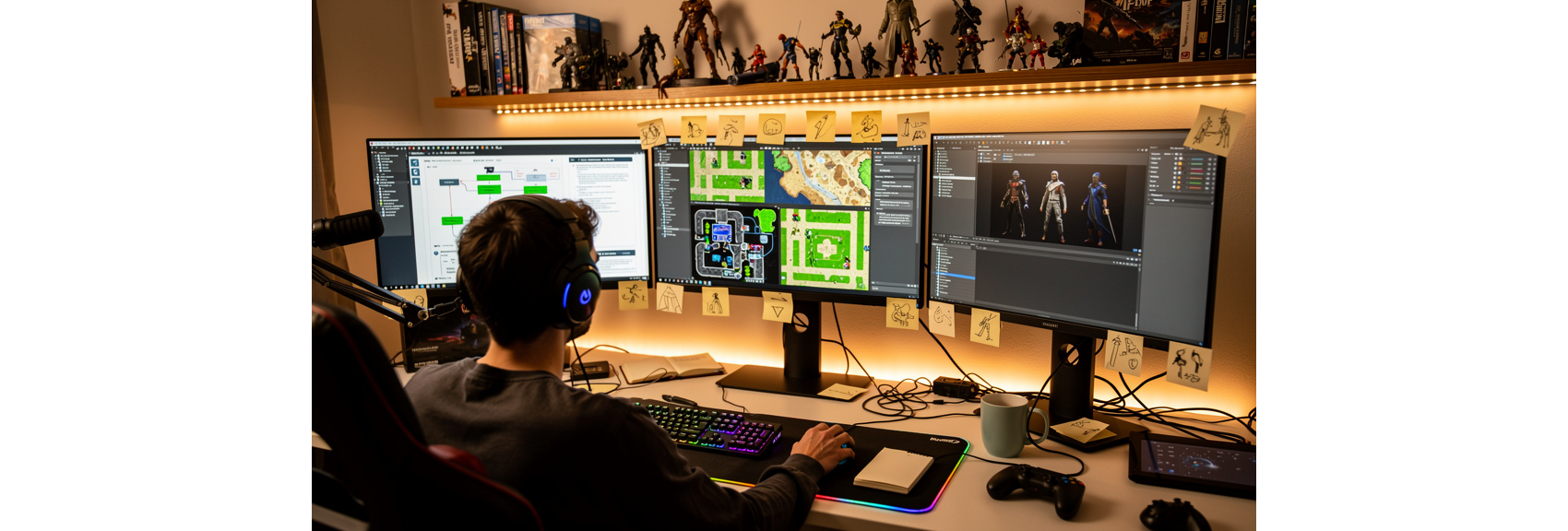
Behind every shipped title is a group of specialists working together. When we talk about the job outlook for game developers, we are really talking about several related paths. The two most common labels, “game designer” and “game developer” or “programmer,” describe different but connected parts of the same process.
Game designers focus on what the player feels and does. They shape the core loop, systems, rules, story, characters, and moment‑to‑moment experience. Game developers or programmers focus on how everything actually runs, from physics to AI to networking to tools. Around them stand character artists, animators, environment artists, UI and UX designers, sound designers, writers, producers, QA testers, and quality analysts. Modern teams rely heavily on clear communication, shared tools, and tight feedback loops.
“A game is a series of interesting decisions.”
— Sid Meier, game designer
That quote sums up how many roles fit together: every specialist helps shape those decisions, either on the design side or in the code and content that bring them to life.
Core Skills For Game Developers
For programmers, the job outlook for game developers depends strongly on technical depth. Hiring managers look first for solid command of languages such as C++ and C#, since most major engines and internal tools rely on them. Many teams also value Python and scripting languages for pipelines, tools, and gameplay logic.
Key technical skills include:
- Hands‑on experience with Unity and/or Unreal Engine, including prefabs or blueprints, performance profiling, and build pipelines
- Understanding of software architecture and common design patterns to keep complex projects maintainable
- Cross‑platform development experience (console, PC, and mobile) from one shared codebase
- Day‑to‑day use of version control tools like Git, plus code review habits and clear commit history
- Familiarity with AI and machine learning basics, even if not working as a full specialist
Soft skills also matter: communicating clearly in stand‑ups, working within sprints, and giving constructive feedback strengthen a developer’s impact and make career progression smoother.
Core Skills For Game Designers
For designers, the job outlook for game developers connects to a different skill mix. Strong storytelling and worldbuilding help create settings and characters players care about. An understanding of game mechanics, player psychology, and motivation shapes rewards, difficulty curves, and pacing. UX thinking keeps screens and controls clear so players can focus on the fun instead of the menus.
Core design abilities often include:
- Prototyping ideas using engine tools, visual scripting, or simple code
- Level design and encounter design that guide the player through spaces and challenges
- Game balance, tuning systems, rewards, and economies using both intuition and data
- Basic coding or scripting knowledge to communicate better with engineers and test ideas directly
- Strong documentation and communication, from pitch decks to design specs and feedback notes
Above all, designers need the ability to think like a player, predict behavior, and adjust systems based on feedback and data.
Career Progression From Junior Developer To Industry Leader

A healthy job outlook for game developers does not just mean “can I get a job”; it also raises the question “how far can I go.” Most careers start in junior roles, where people fix bugs, build small features, and support more senior staff on specific tasks. This phase is about learning engines, processes, and how a studio actually ships.
A key factor in growth is the number and scale of shipped titles. A shipped title is a game that has gone from concept through production to launch, often with live updates after release. Studios trust candidates who have lived through crunch points, changing priorities, and post‑launch support. Someone with several shipped projects, even small ones, signals that they understand the full cycle and can handle responsibility.
A typical progression might look like:
- Junior Developer / Designer – fixes bugs, handles well‑scoped tasks, learns tools and pipelines
- Mid‑Level – owns features or levels, contributes ideas, mentors interns or juniors
- Senior – leads systems or major features, influences roadmaps, supports cross‑disciplinary work
- Lead – manages a team, coordinates across departments, sets standards and practices
- Director / Principal – shapes vision, strategy, and high‑level decisions across multiple teams or projects
Many people spend three to five years between each major step, though the timeline shrinks when someone ships more titles, takes on mentoring, or specializes in hot areas like online systems or AI. Some choose to go the indie route, founding small studios, freelancing across clients, or building their own IP. Others stay inside larger companies and lead sizable teams.
“A delayed game is eventually good, but a rushed game is forever bad.”
— Shigeru Miyamoto
That mindset also applies to careers: consistent, thoughtful growth tends to beat rushing into senior titles before the skills and experience are ready.
Continuous learning ties all of this together. New tools, consoles, and business models keep arriving, which means the job outlook for game developers favors people who stay curious and keep building real work. At Video Game Jobs, we not only share open roles at each level, but also publish career tips that help developers and designers plan their next step with intention.
Top Companies And Current Hiring Outlook
Another way to understand the job outlook for game developers is to look at who is hiring and what they are paying. The U.S. market includes some of the biggest names in entertainment and tech, and they all depend on steady streams of game talent.
Major publishers and platform owners such as Activision Blizzard, Electronic Arts (EA), Take‑Two Interactive, Zynga, and Microsoft often have long lists of openings. At Microsoft, roles like Senior Product Designer or Lead Game Systems Designer can fall in the $100k to $200k range, and Senior Software Engineers on large franchises may earn even more. EA posts positions like Game Designer II in the roughly $49k to $79k band, UX Designers near or above $89k, and Senior Software Engineers well over $200k in some cases.
Newer platforms and service‑focused companies also shape the job outlook for game developers. Roblox hires Principal Product Designers in the mid‑$200k range and Senior Data Center Operations Engineers well into six figures. Ubisoft lists Senior Game Programmers in the $52k to $97k band and Gameplay Security Engineers from $100k upward. Tech contractors such as SAIC recruit UX and full‑stack developers who work on simulation and training projects that use game tech.
These employers range from AAA console studios to mobile‑first companies, live service giants, and indie publishers with small but steady teams. Many are open to hybrid or remote setups, contract‑to‑hire deals, and flexible schedules, as long as the work gets done and shipped. On Video Game Jobs, we gather openings from these large names and from smaller studios, so candidates can see the full spread of options in one place instead of hunting across general job boards.
Future Trends Shaping Game Development Careers
The job outlook for game developers is not static; it keeps shifting with new hardware, player habits, and business models. People who grow with these changes tend to have more freedom in where they work and which teams they join. That makes it important to track not just where the jobs are today, but where they are heading.
Emerging Technologies And Their Impact
Several technology trends are now shaping what studios look for in candidates:
- Artificial intelligence (AI) and machine learning (ML) are moving from research decks into daily production. Teams use them to build smarter NPCs, generate levels and assets, tune difficulty, and personalize content. Developers who understand how to integrate AI systems, even at a basic level, add real value and strengthen the job outlook for game developers who invest in these skills.
- Cloud gaming services such as Xbox Cloud Gaming and PlayStation Plus need engineers who can handle streaming, latency, and server‑side logic. Building games that run smoothly on weaker hardware but rely on strong back‑end systems is a different challenge than classic console‑only work.
- Cross‑platform development is now standard for many releases, so Unity and Unreal Engine skills that cover console, PC, and mobile from one core codebase are in high demand.
- On mobile, hyper‑casual games reward teams that can prototype quickly, test user behavior, and ship updates faster than the competition. Monetization design, ad integration, and retention metrics all matter here.
- Data science has become part of everyday game development. Studios study player behavior, churn, spending, and engagement, then feed that back into design choices. Some teams even explore the Internet of Things (IoT) to connect games with wearables, smart TVs, and other devices.
All of these trends open fresh roles and keep the job outlook for game developers moving upward for people who learn in these areas.
The Remote Work Evolution
Remote and hybrid work changed game careers in lasting ways. Many studios that once hired only on‑site staff now support fully remote teams spread across several states or even countries. Hybrid setups, where people spend part of the week in the office, are also common. This shift lets more developers live where they prefer while working for top studios.
Some common patterns include:
- Fully remote roles for programmers, designers, and artists, often with flexible hours
- Hybrid roles concentrated near hubs like Seattle, Los Angeles, Austin, or Montreal
- Location‑based pay policies, where salary bands shift depending on the employee’s region
There are trade‑offs. Some employers still reserve certain senior or leadership roles for people who can be in the office regularly, and time zones can limit collaboration. On Video Game Jobs, we clearly flag on‑site, hybrid, and remote options so the job outlook for game developers includes both career level and lifestyle fit.
Conclusion
When we pull all the data together, the picture is clear. A strong global market and a 22 percent projected growth rate for software developers give the job outlook for game developers a solid base through the rest of the decade. Demand spans code, design, art, production, data, and QA, with steady hiring in both giant publishers and smaller studios.
For individuals, this means now is a good time to enter the field or move up a level. Building in‑demand skills, learning core engines, and shipping titles matter more than any single degree. Where you live, which platforms you focus on, and how you keep learning will shape your personal results, but the field as a whole looks healthy. Remote work and fast‑moving tech like AI, cloud gaming, and cross‑platform tools only add more options.
At Video Game Jobs, we focus only on this industry, so every listing, article, and resource is built for people who care about games as work, not just as a hobby. If you want to use the current job outlook for game developers to your advantage, start by exploring our curated roles, updating your portfolio, and reaching out to studios that match your goals. The next great title needs a team, and there is room on that team for people ready to grow.
FAQs
Questions about the job outlook for game developers come up often, whether someone is just starting school or thinking about a mid‑career switch. These quick answers cover the basics and give a starting point for deeper research.
Question 1: What Qualifications Do I Need To Become A Game Developer?
Most game developers start with a bachelor’s degree in computer science, software engineering, or game development. Some come from bootcamps or self‑taught paths backed by strong portfolios. You will need solid skills in C++ or C#, plus experience with engines like Unity or Unreal Engine. In the end, shipped projects and clear, working code matter more than the exact diploma.
Question 2: Is Game Development A Stable Career Choice In 2024?
Yes, for many people it is a stable and promising path. The U.S. gaming market sits near $57.91 billion and is projected to reach $90.79 billion by 2029. Software developer roles, which include many game jobs, are expected to grow by about 22 percent through 2030. While studios can still have ups and downs, the long‑term job outlook for game developers remains positive.
Question 3: How Long Does It Take To Become A Senior Game Developer?
For most people, moving from junior to senior takes about five to eight years. Progress tends to be faster when you ship several titles and take on harder tasks over time. Specializing in key areas such as online systems, gameplay engineering, or AI can also speed things up. Quality of experience and impact on projects usually matter more than just counting years.
Question 4: Can I Work Remotely As A Game Developer?
Yes, remote work is now common across many studios. Plenty of teams hire fully remote programmers, designers, and artists, while others offer flexible hybrid setups. Some companies use location‑based pay, so salaries may change by region. On Video Game Jobs, you can filter for remote openings to match your skills and preferred way of working.
Question 5: What Is The Difference Between A Game Designer And A Game Developer?
A game designer focuses on what the player does and feels. They shape rules, systems, story, levels, and the overall experience. A game developer or programmer writes the code that makes those ideas run, handling logic, performance, tools, and technical systems. In small teams the roles can overlap, but the core skill sets and pay bands are often different.
Question 6: Which Game Development Skills Are Most In-Demand Right Now?
Studios still look first for strong C++ and C# skills and real experience with Unity or Unreal Engine. Cross‑platform development, performance tuning, and solid Git habits also rank high. On the emerging side, AI and machine learning, cloud gaming knowledge, and data analysis are growing fast. Soft skills such as teamwork, problem‑solving, and adaptability round out a strong profile, and you will see them reflected in many listings on Video Game Jobs.